
TOXOPLASMA GONDII: From cat litter to Brain Chemistry
- Sanjana SB

- Sep 17, 2025
- 3 min read

-Nearly one third of the planet is infected with a parasite that affects the brain and pushes people toward impulsive and risky behaviour
Introduction:
Toxoplasma gondii is a protozoan parasite that infects up to a third of the world's population. Infection is mainly acquired by ingestion of food or water that is contaminated with oocysts shed by cats or by eating undercooked or raw meat containing tissue cysts.
Behavioural changes in humans:
T. gondii infection may trigger changes in impulsivity control, including an increase in general risk-taking behaviors and violence, where seropositive female individuals were found to exhibit increased levels of aggression, while male individuals were characterized by excessive impulsiveness. Furthermore, in regard to neurocognitive function, the latent infection was connected with psychomotor deficits, lack of concentration, lower intelligence quotient (IQ), and alterations in personality profile.
It increases the production of dopamine- a chemical linked to pleasure, motivation and reward-driven actions like eating, sleeping, and sex
Excess dopamine can trigger aggression, impulsive decisions and risky sexual behaviour
In severe cases it may also contribute to mental disorders
Mechanism:
Once it enters the body, the parasite changes into a fast-moving form that can sneak into brain cells. It uses a special “drill-like” structure to push its way inside. Once in, it builds a protective bubble around itself so the cell’s defenses can’t destroy it. After some time, the parasite slows down and changes into a “sleeping” form. These sleeping forms, called cysts, stay hidden inside brain cells, the eye, and muscles. They can remain there for life without being noticed. Scientists think the parasite may affect the brain’s chemical messengers, especially those linked with mood and risk-taking, like dopamine. This could explain why infected people (and animals) sometimes show changes in mood, reaction time, or risk-taking behavior. If a pregnant woman gets infected, the parasite can reach the baby’s brain. In babies, the infection can cause serious damage, especially in areas that control movement and thinking. Sometimes it blocks fluid flow in the brain, leading to swelling (hydrocephalus).

Links with Psychiatric & Neurological Conditions:
Some cases of acute toxoplasmosis in adults are associated with psychiatric symptoms such as delusions and hallucinations. A review of 114 cases of acquired toxoplasmosis noted that “psychiatric disturbances were very frequent” in 24 of the case-patients. The parasite’s ability to form cysts in the brain and influence dopamine metabolism provides a possible biological explanation, since dopamine imbalance is central to schizophrenia.
Other associations include bipolar disorder, depression, and anxiety, where chronic low-level brain inflammation from the parasite might contribute to mood changes. Research has also suggested that T. gondii could increase suicidal tendencies or contribute to impulsivity and aggression, potentially explaining higher rates of risky behavior and even road traffic accidents among infected individuals.
That said, these findings remain controversial. Some large studies support the association, while others find weak or no correlation, suggesting that environmental, genetic, and socioeconomic factors may also play a role. What’s clear, though, is that Toxoplasma offers a unique window into how infections can potentially interact with the brain and influence behavior.
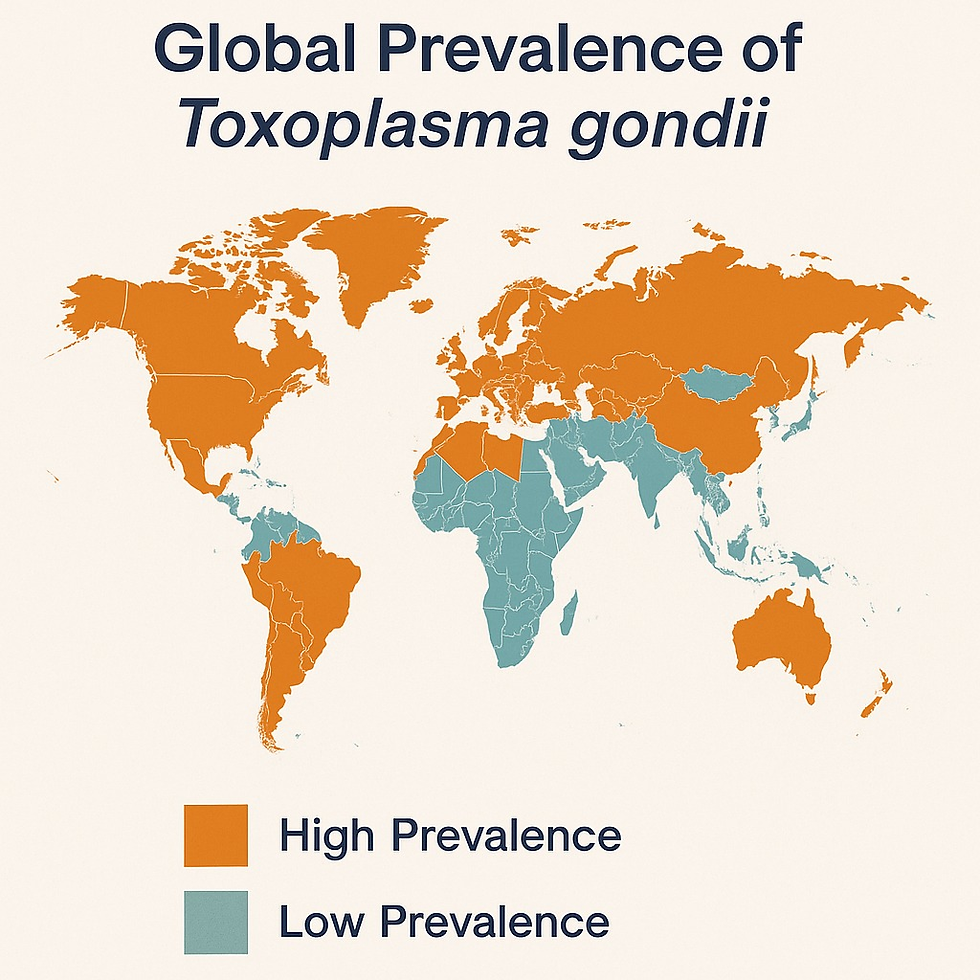
Global Prevalence - Why It’s Not Just Rare Trivia.
Toxoplasma gondii is one of the most widespread parasites in the world. It’s estimated that around one-third of the global population carries it often without even knowing. The prevalence, however, varies greatly between countries and cultures. For example, infection rates are higher in places where people frequently eat undercooked or raw meat (such as in parts of France and Brazil), while in other regions, contaminated water supplies are a bigger source of transmission.
Because the parasite forms lifelong cysts in tissues, once infected, a person may carry it for life. This means billions of people around the world are living with it silently, making it far more than just a medical curiosity. In fact, the sheer scale of infection raises important public health questions, especially if the parasite really does influence human behavior and risk-taking tendencies. If even subtle changes in decision-making occur across large populations, Toxoplasma could be shaping society in ways we don’t fully understand yet.
If a parasite can influence our choices, how much of ‘free will’ is actually free?
References:
1.Wastling J, Heap S, Ferguson D. Toxoplasma gondii—keeping our guests under control. Biologist (London). 2000;47:234–8. [PubMed] [Google Scholar]
2.Tenter AM, Heckeroth AR, Weiss LM. Toxoplasma gondii: from animals to humans. Int J Parasitol. 2000;30:1217–58. 10.1016/S0020-7519(00)00124-7 [DOI] [PMC free article] [PubMed] [Google Scholar]
3.Suzuki Y. Host resistance in the brain against Toxoplasma gondii. J Infect Dis. 2002;185(suppl 1):S58–65. 10.1086/337999 [DOI] [PubMed] [Google Scholar]
4.Elsheikha HM, Büsselberg D, Zhu XQ. The known and missing links between Toxoplasma gondii and schizophrenia. Metab Brain Dis. 2016 Aug;31(4):749-59. doi:


Comments